…an Ancient Talisman
May I Come In?
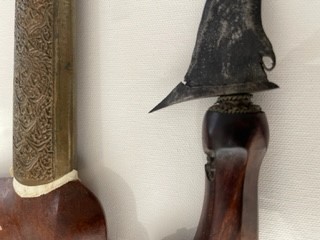
Estate sales feel so intrusive. Entering someone’s home where you can peruse through their possessions, observe their decorative tastes, how they kept their home, the smells, and the dust made from their own skin cells (weird, I know) just seems a bit, personal, particularly if they’ve passed on. As crazy as it may seem, whenever I enter an estate sale, I mentally thank the owner for welcoming me into their home and ask them to point me to something that was special to him/her. I purchased this Kris/Keris sword at such a sale and all I know of the previous owner is that he was a well-decorated military veteran. There were many military coins, medals, lapel pins and other knives/weapons for sale. This one caught my eye because of its unusually shaped blade and handle. Knowing nothing of its origin I did an image search to find similar objects, et voila! At first, I was slightly regretful of my purchase after reading the information on the internet about a Kris’ “power” and “spirit,” sometimes good and sometimes menacing and how it should be cleaned in a special way once a year to preserve its spirit and not anger it. It may also have been soaked in poison so as to cause certain death to its enemy if the blade wasn’t enough. So, I did what any logical person would do and put it on the cabinet above my stove where it would not be seen/touched by others until I could figure out how to get rid of it. I’ve since become a little less concerned about it and after more research, decided to embrace it as something that was “passed on” to me by the owner.
Period: 1200’s ? – present
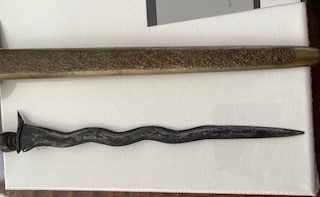
A Kris or Keris sword hails from the Southeast Asia region and was worn both ceremoniously & during battle and their production is said to have begun in the 1200’s. As varied as the islands in this area, so are the Kris swords. They are forged in different shapes and sizes using different materials depending on the region. However, there has been much crossover in modern times which makes them more difficult to date and pinpoint the origin. There are however, some constants in the making of the Kris sword, assuming it is authentic and made by a legit Empu (maker): a flared base (ganja), a double-edged blade that is either straight or waved, the blade has patterns that are made by forging anywhere from 3-50 types of metals together (pamor). The process of making a genuine Kris may take up to a year and the maker follows strict guidelines in constructing it. Most interesting is the mystical properties that these swords are thought to have. They serve as protective talisman to the owners and are said to possess spirits of their own which serve different purposes for the owner, depending on how they are forged. They are heirloom objects passed down in families. In the 1970’s Kris swords were produced as souvenirs for tourists, flooding the market with reproductions that lacked the skill and sacredness of the swords produced by an Empu. There’s so much more information that could be written about Kris swords, and we can’t fit it all here, so we will move on to talk about this one.

What’s it Worth?
Estimated value would be difficult to determine. You can see from the sticker what I paid for it (although I’m certain I didn’t pay full price.) I couldn’t even venture a guess on the time period of this particular sword. Seeing how the gentlemen I acquired it from was in the military and traveled, it may have been purchased as a tourist souvenir on his travels (the time period fits) or it may have been gifted to him if he was highly decorated or admired for his accomplishments. This, we will never know. It seems to follow the design of the Balinese swords (Bawa). It is very oxidized and has a dark patina which I will not dare wipe off. The wood is smooth and rich in color. The hilt (representing a person or animal) is darker which makes sense if it was handled more that the sheath. The wooden part of the sheath (representing a boat) has come loose from the metal piece that holds the blade and the owner stuffed folded paper inside of it to make the fit tight. It’s not particularly ornate, certainly not like some of the examples I’ve seen online, but that may mean that it is more utilitarian and may have been actually used. Or maybe it’s a touristy reproduction?? The blade (representing waves of the ocean) is delicate and wavy. It has 7 luks (waves), which stands for: honest, lucky charm/tolak balak (dapur carubuk)[1] and would be worn by palace officials such as the Laksamana (admiral) or Panglima (commander). [2]
I think I’ll keep it!
Talk to me… (Click on Comments in upper left)
Do you have a Kris or Keris sword or have any experience with them to share? I’d love to hear about it!
- Luk | Atkinson Swords | David Atkinson (atkinson-swords.com)
- Your Ultimate Guide to Keris: Dagger of Life and Death — Total Urban Survival
 Antiques at Home
Leave a comment